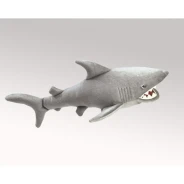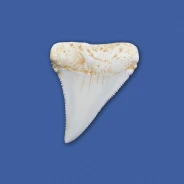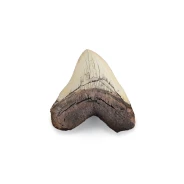
What better way to introduce young scientists to the amazing world of sharks than with our make-your-own Shark Tooth Necklace Activity Kit? Children are fascinated by sharks - they'll love to learn about how long sharks have been around, how big they can get and how many teeth they have (up to 3,000!).
Ages 6 and up.
Unit Goals and Concepts:
- Understand how sharks are different from other types of fish.
- Increase awareness of varieties of sharks and their habitats.
- Learn about shark teeth, and then make a necklace using one.
Materials Included:
- Real shark teeth (approximately 1 cm each), beads and necklace materials. Shark teeth are typically Whitetip Shark, Bull Shark or Tiger Shark teeth.
- Our exclusive instructor's activity guide, which details the project and offers loads of other ideas. A reproducible page offers fun facts about sharks, a shark puzzle and more. Loads of instructor activity ideas are included.
General: National Science Education Standard NS.K-4.3 and NS.5-8.3 Life Science.
Content Standard C: The Characteristics of Organisms (K-4)
Each plant or animal has different structures that serve different functions in growth, survival, and reproduction.
The Life Cycles of Organisms (K-4)
Plants and animals have life cycles that include being born, developing into adults, reproducing, and eventually dying. The details of this life cycle are different for different organisms.
Organisms and their Environments (K-4)
Humans depend on their natural and constructed environments. Humans change environments in ways that can be either beneficial or detrimental for themselves and other organisms.
Structures and Functions in Living Systems (5-8)
Living systems at all levels of organization demonstrate the complementary nature of structure and function. Important levels of organization for structure and function include cells, organs, tissues, organ systems, whole organisms, and ecosystems.
Reproduction and Heredity (5-8)
Reproduction is a characteristic of all living systems; because no individual organism lives forever, reproduction is essential to the continuation of every species.
Specific (California standards):
(K.2c) Students know how to identify major structures of common plants and animals.
(1.2a) Students know different plants and animals inhabit different kinds of environments and have external features that help them thrive in different kinds of places.
(1.2d) Students know how to infer what animals eat from the shapes of their teeth.
(2.2a) Students know that organisms reproduce offspring of their own kind and that the offspring resemble their parents and one another.
(2.2b) Students know the sequential stages of life cycles are different for different animals.
(2.2d) Students know there is variation among individuals of one kind within a population.
(3.3a) Students know plants and animals have structures that serve different functions in growth, survival, and reproduction.
(3.3e) Students know that some kinds of organisms that once lived on Earth have completely disappeared and that some of those resembled others that are alive today.