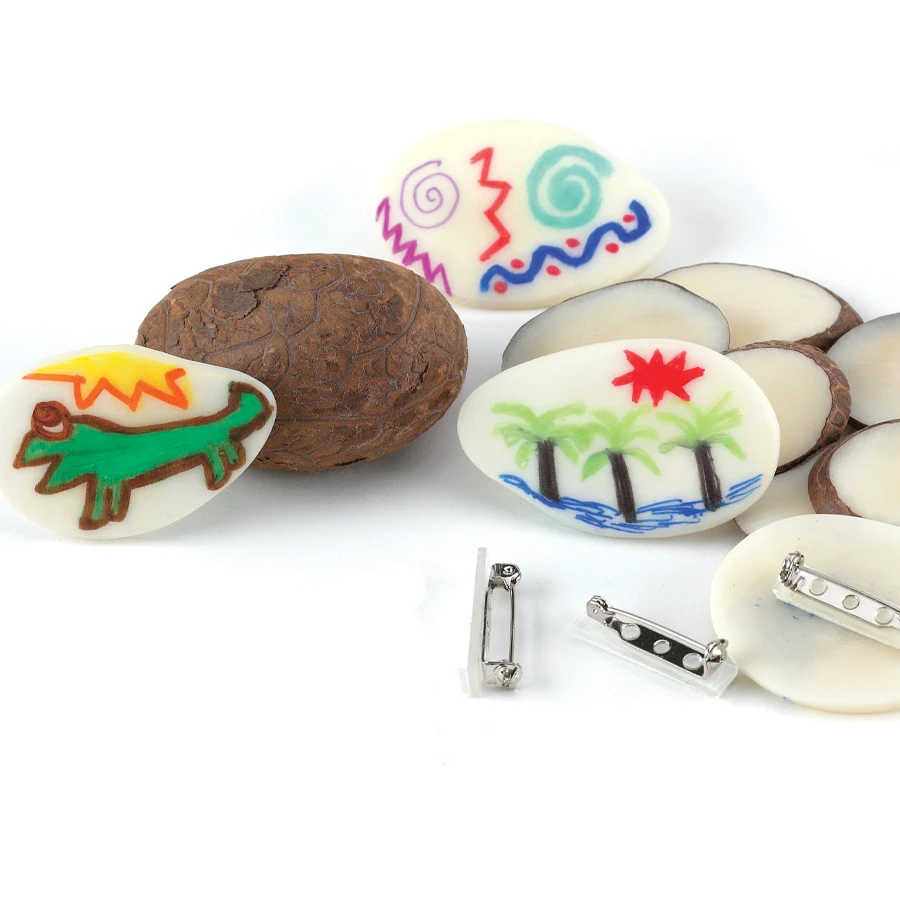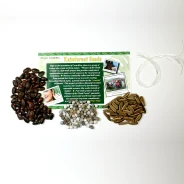
Did you know that half the world's animal and plant species reside in rainforests? The Amazon Rainforest alone contains 1600 bird species, 1,000,000 insect species and 30,000 different plants. One quarter of all medicine in the world comes from the rainforest. But the Amazon Rainforest is being destroyed at the rate of 1 acre per second! In our exclusive Rainforest Ramble project, kids explore and appreciate the wonderment of the rainforest as they learn to identify and use sustainable products that contribute to its preservation.
Ages 6 and up. This kit contains tree nuts. Please be aware of any participant who may be allergic.
Unit Goals and Concepts:
- Discuss some of the problems and issues concerning the rainforest.
- Examine and sample some rainforest products.
- Learn about some of the animals that live in the rainforest.
- Become familiar with the concept of sustainable development.
Materials Included:
- A tagua nut slice (which makes a great natural "canvas" for young artists), plus an adhesive pin back for each participant to make his or her own tagua nut pin.
- A "Rainforest Sample Set" to show children all the different products that are created from items in the rainforest, including coffee, gum, balloons and more!
- Our exclusive instructor's activity guide that makes planning the project easy and delivers loads of fun ideas for rainforest activities, games and relevant projects.
- The only materials you supply are markers and rainforest snacks.
General: National Science Education Standard NS.K-4.3, NS.K-4.6, NS.5-8.3 and NS.5-8.6 Science in Personal and Social Perspective and Life Science.
Content Standard C: Characteristics of Organisms (K-4)
Organisms have basic needs. Organisms can survive only in environments in which their needs can be met. The world has many different environments, and distinct environments support the life of different types of organisms.
Organisms and their Environments (K-4)
An organism’s patterns of behavior are related to the nature of that organism’s environment.
Populations and Ecosystems (5-8)
The number of organisms an ecosystem can support depends on the resources available and abiotic factors, such as quantity of light and water, range of temperatures, and soul composition.
Content Standard F: Types of Resources (K-4)
Some resources are basic materials; some are produced from basic resources; and some resources are nonmaterial.
The supply of many resources is limited. If used, resources can be extended through recycling and decreased use.
Changes in Environments (K-4)
Changes in environments can be natural or influenced by humans. Some changes are good, some are bad, and some are neither good nor bad. Pollution is a change in the environment that can influence the health, survival, or activities of organisms, including humans.
Specific (California standards):
(3.3b) Students know example of diverse life forms in different environments.
(3.3c) Students know living things cause changes in the environment in which they live: some of these changes are detrimental to the organism or other organisms, and some are beneficial.
(4.3a) Students know ecosystems can be characterized by their living and nonliving components.
(6.5e) Students know the number and types of organisms an ecosystem can support depends on the resources available and on abiotic factors.
(Health Standard 1.1.P.8) Identify materials that can be reduced, reused, or recycled.
(Health Standard 3.1.P.6) Discuss how reducing, recycling, and reusing products make for a healthier environment.