Teaching young people about endangered animals is a critical step toward enhancing awareness....and here's a really fun way to do just that!
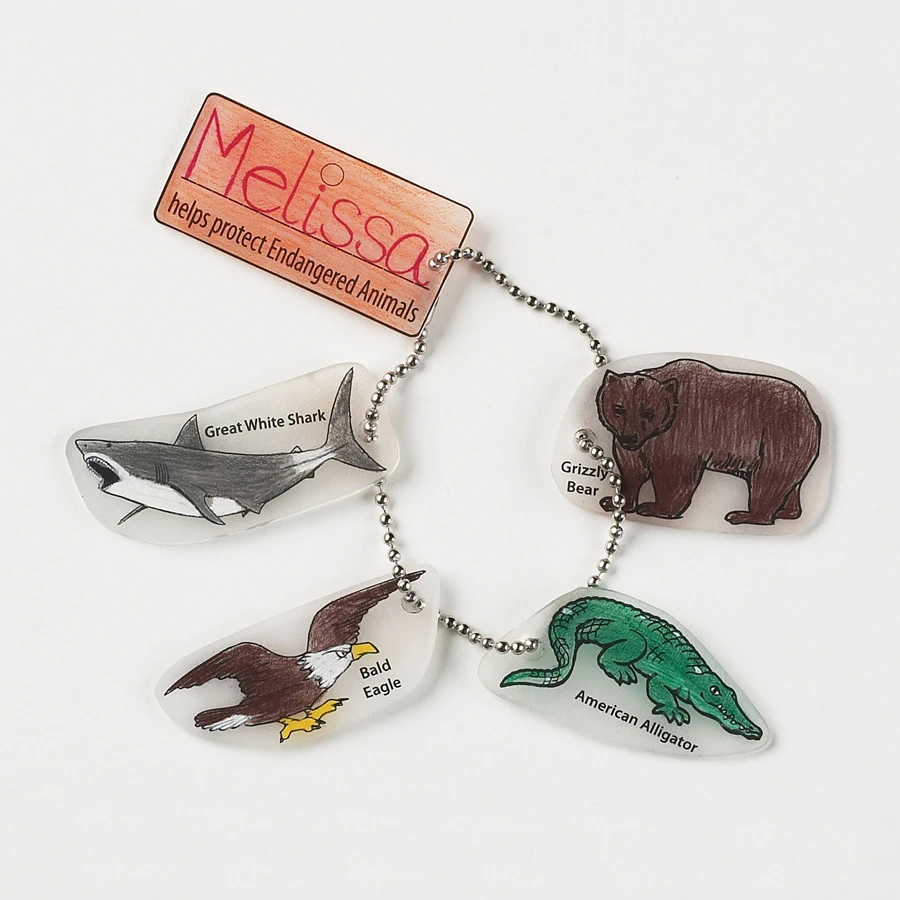
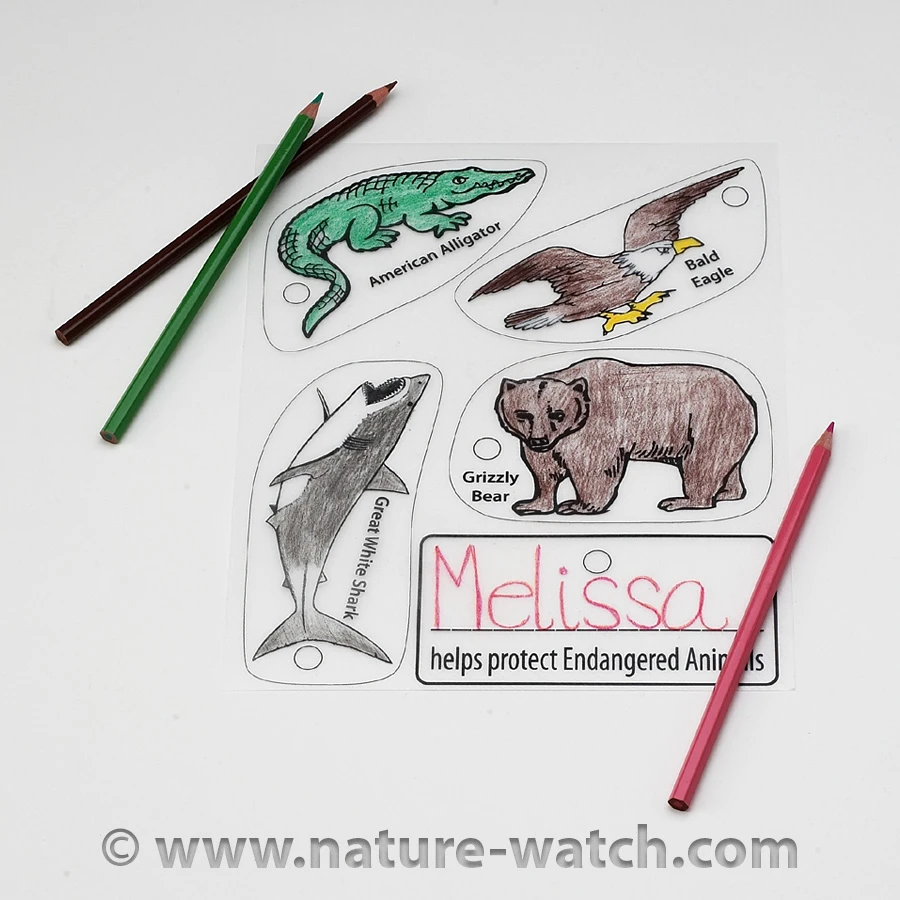
Each child colors-in and cuts-out a sheet of plastic that we have specially printed with 4 endangered animals and a name tag. (Grizzly Bear, Great White Shark, American Alligator and Bald Eagle). An adult then bakes the project in an oven (or toaster oven) for about 1 minute. SHRINKY DINKS(r) are "magical" because after baking, plastic pieces shrink to approximately 1/3rd their original size, become 9 times thicker and colors intensify! Slip the included chain through the five pieces and there you have it - a keychain or backpack tag with a purpose!
Our exclusive activity guide provides all of the information needed to teach about endangered animals - even if the instructor has no previous knowledge on this subject. Ages 4 and up.
Unit Goals and Concepts:
- Learn about animals that are currently endangered.
- Discover ways to protect and save endangered animals.
- Make an Endangered Animals Keychain with amazing shrinking Shrinky Dinks(r).
Materials Included:
- All the materials you'll need to make your Endangered Animals keychain.
- Our exclusive instructor's activity guide that makes planning the project easy and delivers loads of fun ideas for activities, games and relevant projects. Also includes a reproducible worksheet for your participants.

General: National Science Education Standard NS.K-4.3, NS.K-4.6, and NS.5-8.6 Science in Personal and Social Perspective and Life Science.
Content Standard C: Organisms and their Environments (K-4)
An organism’s patterns of behavior are related to the nature of that organism’s environment. When the environment changes, some plants and animals survive and reproduce, and others die or move to new locations.
All organisms cause changes in the environment where they live. Some are detrimental, whereas others are beneficial.
Humans change environments in ways that can be either beneficial or detrimental for themselves and other organisms.
The Characteristics of Organisms (K-4)
Organisms have basic needs. They can survive only in environments in which their needs can be met.
Populations and Ecosystems (5-8)
Populations of organisms can be categorized by the function they serve in an ecosystem. Food webs identify the relationships among producers, consumers, and decomposers in an ecosystem.The number of organisms an ecosystem can support depends on the resources available. Lack of resources and other factors, such as predation and climate, limit the growth of populations in the ecosystem.
Diversity and Adaptations of Organisms (5-8)
Extinction of a species occurs when the environment changes and the adaptive characteristics of a species are insufficient to allow its survival.
Content Standard F: Changes in Environments (K-4)
Changes in environments can be natural or influenced by humans. Pollution is a change in the environment that can influence the health, survival, or activities of organisms, including humans.
Natural Hazards (5-8)
Human activities also can induce hazards through resource acquisition, urban growth, land-use decisions, and waste disposal. Such activities can accelerate many natural changes.
Specific (California standards):
(3.3c) Students know living things cause changes in the environment in which they live; some are detrimental and others are beneficial.
(3.3d) Students know when an environment changes, some plants and animals survive and reproduce; others die or move to new locations.
(3.3e) Students know that some kinds of organisms that once lived on Earth have completely disappeared and that some of those resembled others that are alive today.
(4.2b) Students know producers and consumers are related in food chains and food webs and may compete with each other for resources in an ecosystem.
(4.3b) Students know that in any particular environment, some kinds of plants and animals survive well, some survive less well, and some cannot survive at all.
(Health Standard 1.1.P.7) Discuss how individual behavior affects the environment and community.
(Health Standard 3.1.P.6) Discuss how reducing, recycling, and reusing products make for a healthier environment.
(Health Standard 5.1.P.6) Explain that all individuals have a responsibility to protect and preserve the environment.
(Health Standard 7/8.1.P.10) Identify human activities that contribute environmental challenges (e.g., high-emission vehicles, water pollution, and noise pollution).